

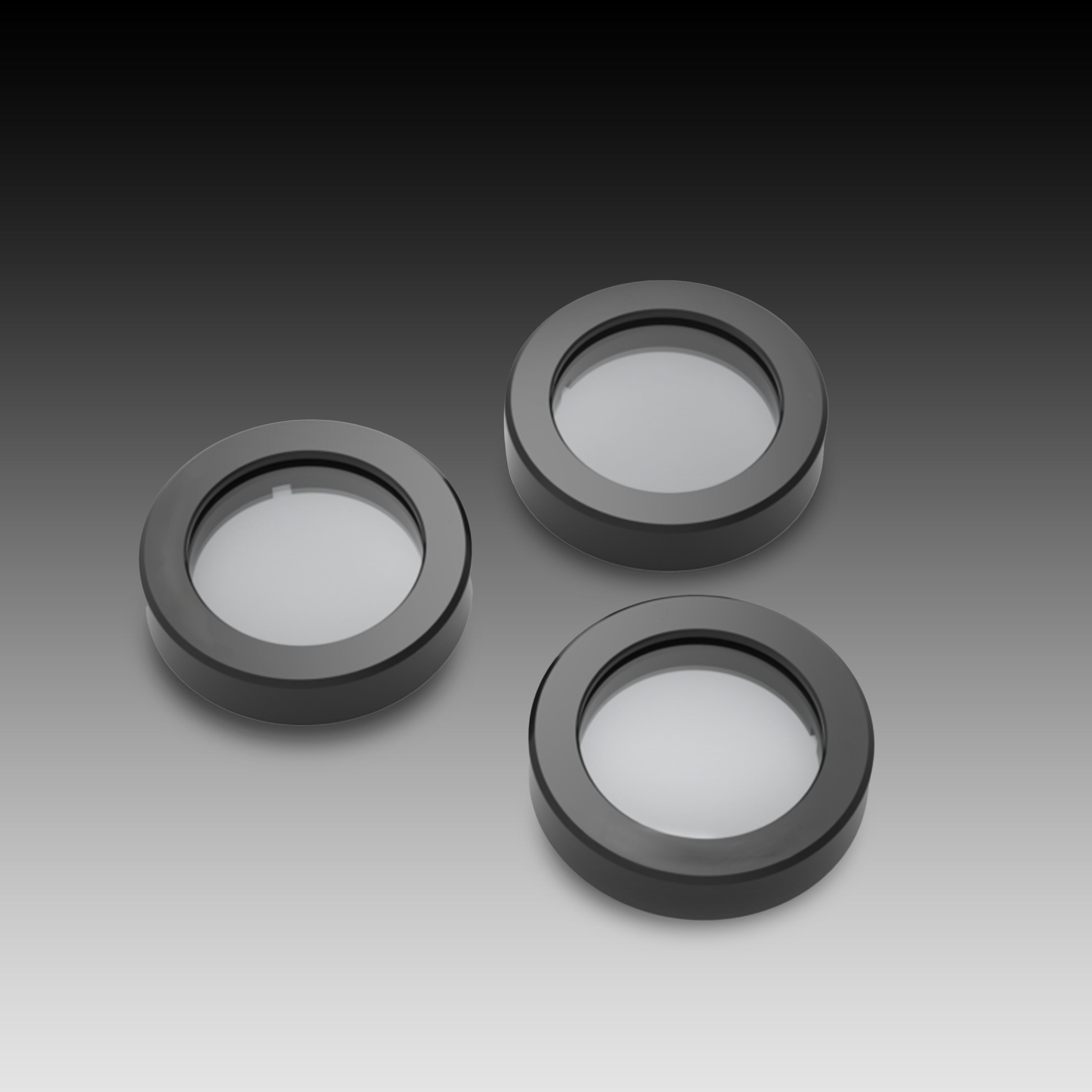
Achromatic Half Wave Plate
Achromatic Quarter waveplates consist of two different materials that are carefully chosen to eliminate chromatic dispersion.
Achromatic waveplates consist of two different materials that are carefully chosen to eliminate chromatic dispersion. The use of crystalline quartz with magnesium fluoride or UV sapphire minimizes the wavelength dependence of the retardation such that a nearly flat spectral response is achieved over the entire operating range of the achromatic wave plate. Compared to zero-order waveplates, achromatic waveplates offer better retardation accuracy over broadband wavelength ranges.
- AR Coating Range 400-800nm
- Reflectance (coating) R avg< 0.5% per surface
- RETARDANCE ACCURACY : λ/40
- Damage Threshold 5 J/cm2
- Material Crystalline Quartz and Magnesium fluoride
- SURFACE QUALITY – 40-20.
CUSTOM DESIGN ALSO AVAILABLE .
Related Products
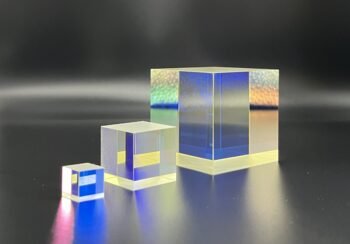
A broadband polarizing beam splitter is an optical component engineered to separate or combine light beams based on their polarization state across an exceptionally wide spectral range. It transmits one linear polarization (typically P-polarized light) with high efficiency while reflecting the orthogonal polarization (S-polarized light) at a steep extinction ratio, all while preserving wavefront quality. This makes it indispensable in systems requiring polarization management for tunable lasers, ultrafast sources, or multi-wavelength imaging—where spectral agility is as critical as polarization purity.
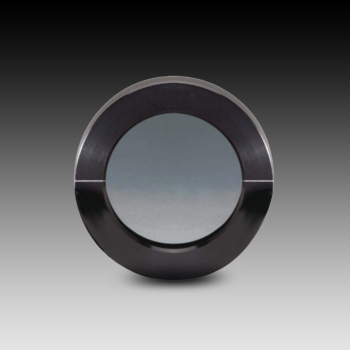
Multi-Order Half-Wave Plate: A waveplate that provides a half-wave phase retardation plus one or more complete 2π phase cycles, designed for a specific wavelength. It is generally more economical than a zero-order waveplate.

A Nicol prism is a type of polarizer, an optical device made from calcite crystal used to produce and analyzer plane polarized light. It is made in such a way that it eliminates one of the rays by total internal reflection, i.e. the ordinary ray is eliminated and only the extraordinary ray is transmitted through the prism.
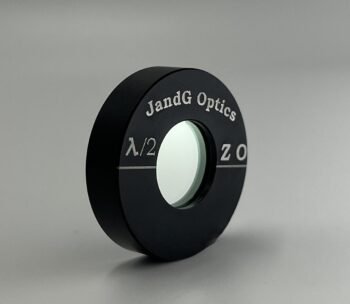
Zero-Order Half-Wave Plates are built by combining two Multi-Order Crystalline Quartz Wave Plates to obtain an optical path length difference of λ/2.